
Eulogy writing guide
How to write a eulogy
Seven steps, a fill-in-the-blank eulogy template, a complete example, how long it should be, and opening and closing lines to copy.

How to write a eulogy in 7 steps
1. Ask how long you have
Before you write a word, ask the officiant or funeral director how long you can speak and who else is speaking. A eulogy written for ten minutes is painful to cut down the night before.
If several people are speaking, agree who covers what, so three speakers don’t all tell the same fishing story.
2. Gather stories from the people who knew them
You don’t have to remember everything yourself. Send a short message to family and close friends and ask for one memory each. Their answers often hold the story that becomes the heart of the eulogy.
Also look through photos, cards and old messages, and write down phrases they always said.
I’ve been asked to give the eulogy for name on day. Could you send me one memory of them, a story, a saying, or something small they always did? Even a line or two helps. Thank you.
3. Choose one thread
A eulogy is a portrait, not a life history. Read through your notes and ask: what is the one thing everyone in the room would agree about them? Their patience, their kitchen, their terrible jokes, the way they showed up.
Build around that. Keep the stories that show it and let the rest go; the obituary and the program can hold the dates and the full list of family.
Example thread: “Ruth never let anyone feel like a guest. You were family the minute you walked in.”
4. Write the opening
Say who you are and how you knew them, then give the room a first picture of the person. Two to four sentences is enough. You don’t need a famous quote to begin; a plain, true sentence about them is stronger.
For those I haven’t met, I’m Daniel, Ruth’s eldest son. If you ever came to Mom’s house, you know she asked two questions before you got your coat off: “Have you eaten?” and “Are you staying?”
5. Tell two or three stories
Stories carry a eulogy. Instead of saying they were generous, tell the time they were. Give each story a place, a moment and a detail people can see.
Mix the tender with the funny. Laughter at a funeral is a relief, as long as the person would have laughed too. Leave out inside jokes that only two people understand.
In 1998 the furnace broke on Christmas Eve. By nine o’clock there were eleven of us in Mom’s kitchen with the oven door open, and she was dealing cards like it had been the plan all along.
6. Write the closing
Come back to your thread, say what they leave behind in the people here, and say goodbye in your own words. Some speakers end with a short line of a poem or a reading, a prayer, or the thing the person always said.
Keep the last sentence short so you can say it while looking up.
Mom, thank you for setting a place for every one of us. We’ll keep the door open. Goodbye, and thank you.
7. Read it aloud, trim, and print it
Read it aloud with a timer. Cut whatever makes you stumble and any sentence that repeats another. Then print it in large type, at least 16 point, double-spaced, with page numbers, and mark where to pause.
Give a second copy to someone you trust who can step in and finish it if you need them to.
How long should a eulogy be?
Most eulogies run 3 to 5 minutes, and rarely more than 10. Read aloud at a calm pace, that is roughly 130 words a minute, so you can plan the length before you write.
| Speaking time | Words | Usually right when |
|---|---|---|
| 2 minutes | about 250 wordsOne of many speakers, or a short tribute from a grandchild | One of many speakers, or a short tribute from a grandchild |
| 3 minutes | about 400 wordsSeveral family members each speaking | Several family members each speaking |
| 5 minutes | about 650 wordsThe usual length for the main eulogy | The usual length for the main eulogy |
| 7 minutes | about 900 wordsThe only speaker at the service | The only speaker at the service |
| 10 minutes | about 1,300 wordsThe longest most services allow; check first | The longest most services allow; check first |
Pauses and tears take time too, so if you have 5 minutes, write about 550 words, not 650.
Eulogy template
A funeral speech template to fill in: copy it, replace the blanks, and add or drop a story to fit your time.
1. Who you are
Good morning / afternoon. For those I haven’t met, I’m your name, name’s relationship.
2. A first picture
If you knew name, you know the one thing everyone would recognize: a habit, a saying, a place.
3. Their life, briefly
Name grew up in place, worked as / spent (number) years work or calling, and married (spouse) / raised (family) / made a home in (town).
4. First story
I keep thinking about a moment: when, where, what happened. That was name: the quality the story shows.
5. Second story
A second memory, from someone else if you like: “When I asked (person) for a memory, they told me…”
6. What they gave us
What name gave all of us was the thread. I see it in a person or a habit that carries it on.
7. Goodbye
A favorite saying, a line of a poem or a prayer, if you wish. Name, thank you for what you are grateful for. We love you, and we’ll miss you.
Need help writing the eulogy?
Answer a few gentle questions about them, choose the tone and length, and the free eulogy writer drafts it for you to edit and print. No account needed.
Help me write the eulogyA complete eulogy example
A eulogy for a mother (about 3 minutes, 400 words), built on the steps above: one thread (an open door), two stories and a short goodbye. Ruth is fictional.
Good morning. For those I haven’t met, I’m Daniel, Ruth’s eldest son. If you ever came to Mom’s house, you know she asked two questions before you got your coat off: “Have you eaten?” and “Are you staying?” The answer to the second one was always yes, whether you knew it yet or not.
Mom grew up on a farm outside Mankato, the fourth of six children, and she said that was where she learned to cook for a crowd and to stretch whatever was in the cupboard. She trained as a nurse, worked nights at St. Joseph’s for twenty-six years, and married Dad, Walter, in 1961. They raised three of us in the yellow house on Elm Street, and somehow that house always held more people than it should have.
I keep thinking about Christmas Eve in 1998, when the furnace broke. Most people would have called it off. By nine o’clock there were eleven of us in Mom’s kitchen with the oven door open for heat, everyone still in their coats, and Mom was dealing cards like it had been the plan all along. My daughter still calls it the best Christmas we ever had.
When I asked the family for memories this week, my cousin Linda told me something I never knew. When Linda was nineteen and had nowhere to go, Mom gave her a key to the house and never once asked for it back. Linda lived with us for a year. Mom never mentioned it to anyone. That was her: she didn’t talk about kindness, she just set another place at the table.
She was also stubborn, and funny, and a fierce opponent at rummy who did not believe in letting grandchildren win. She taught every one of them to play, and then she beat every one of them, and they loved her for it.
What Mom gave all of us was the feeling that we belonged somewhere. I see it in my sister, who has had a neighbor’s kids at her table every Sunday for ten years. I see it in the grandchildren, who still say “Have you eaten?” when you walk in, without knowing where they got it.
Mom, thank you for the yellow house, the open door and the extra chair. We’ll keep setting a place for whoever needs one. We love you, and we’ll miss you every single day.
For more, read our funeral speech samples for a father, a grandmother, a friend and others.
Keep the words
Put the eulogy in the funeral program
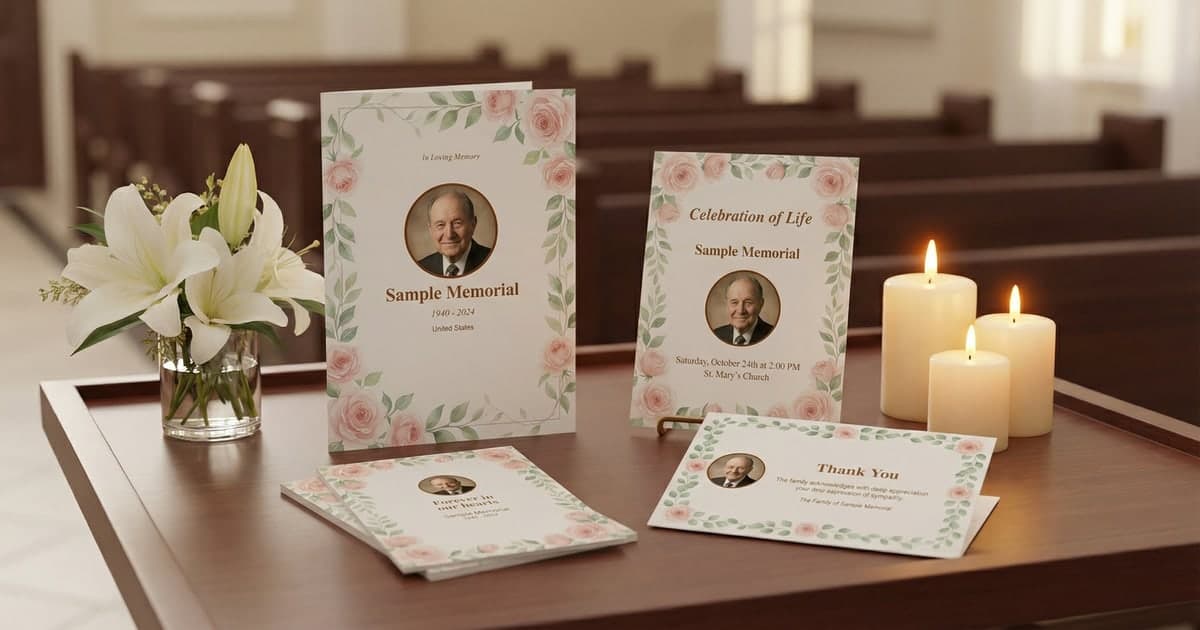
Many families print the eulogy, or a few lines of it, inside the program so people can take it home. Choose from 100s of program themes, add the order of service, photos and the eulogy, then download it or have it printed.
Create a funeral program
How to start and end a eulogy
The first and last lines are the hardest to write and the ones people remember. Borrow one and make it yours.
Opening lines
Say who you are, then give a first picture of them.
For those I haven’t met, I’m name, and I had the good luck of being name’s relationship for number years.
When I sat down to write this, I kept hearing name’s voice telling me to keep it short. I’ll try.
Thank you all for being here. Name would have been amazed at this room, and then asked who was bringing the food.
If you wanted to find name on a Saturday morning, you looked in the garden / the garage / the front pew / the lake.
There is no way to fit name into a few minutes, so I’m going to tell you about one thing: the thread.
Closing lines
Short enough to say while looking up.
Name, thank you for everything you taught us. We’ll take it from here.
The best way we can honor name is to keep doing what they did: the thread, as an action.
So the next time you a small everyday thing they loved, think of name. I know I will.
We were lucky to have you. Rest well, name. We love you.
Goodbye for now, name. Thank you for one specific gift, and for all of it.
More ideas in how to start a funeral speech. To close with a reading, choose a short one from our funeral poems or funeral readings.
What not to say in a eulogy
Family conflict and old grievances
A eulogy is not the place to settle anything. If it would hurt someone in the room, leave it out.
Details the family hasn’t agreed to share
Health, money, the cause of death, past marriages. Ask the closest family when you’re unsure.
Inside jokes and roasts
Humor that only a few people get, or that makes the person look foolish, falls flat in a grieving room.
Too much about you
Your relationship is the lens, but they are the subject. Count the times you say “I”.
A full life history
Dates, every job and every relative belong in the obituary and the program.
Apologies for yourself
Skip “I’m not good at this.” If you cry, pause, breathe and carry on. Everyone in the room is with you.
When a eulogy is hard to write
The relationship was complicated
You don’t have to pretend. Speak honestly about the good you did see, a skill they had, or what they meant to others in the room. Shorter is fine. If you can’t say anything you believe, ask someone else to give the eulogy; that is a kind choice, not a failure.
The death was sudden or tragic
Focus on the life, not the death. You can name the shock in one sentence (“None of us were ready for this”) and then turn to who they were. Leave the cause of death out unless the closest family wants it said.
You’re afraid you won’t get through it
Give a printed copy to a backup reader and agree on a signal. Mark pauses on the page, keep water close, and look at a friendly face. If your voice breaks, stop, breathe and carry on; nobody minds.
You didn’t know them well
Officiants and friends are often asked to speak for someone they knew only in one part of life. Ask three or four family members for a memory each (step 2), and say whose stories you are telling: “His daughter told me…”
After the service
People will ask for a copy. Give the printed pages to the family, or share the eulogy on the person’s free online memorial page, where friends who couldn’t come can read it and leave a message. The free obituary writer helps with the written notice if that still needs doing.
Questions families ask
Who usually gives the eulogy?
Usually someone close to the person: a spouse, an adult child, a sibling or a close friend. Sometimes two or three family members share it, each speaking for a few minutes. If no one in the family feels able to, the officiant or a clergy member can deliver it, or read words the family wrote.
What are the three parts of a eulogy?
An opening, where you say who you are and give a first picture of the person; a middle, with a short outline of their life and two or three stories; and a closing that says what they leave behind and says goodbye.
What is a good last line for a eulogy?
Something short and true that you can say while looking up: a thank-you, a goodbye, or the thing they always said. For example, “We were lucky to have you. Rest well, Dad.” A short line of a favorite poem or prayer also works.
Can I read the eulogy from my phone?
You can, but paper is safer. Phones dim, lock or ring at the wrong moment, and small type is hard to read through tears. Print it in large type, and keep a second copy with someone who can read it for you if needed.
What is the difference between a eulogy and an obituary?
An obituary is written to be read: it announces the death, gives the facts of a life and the service details. A eulogy is spoken at the service, to people who already know those facts, so it can be personal, tell stories and speak directly to the person.
The example eulogy, template and lines on this page were written for FuneralFolio and are free to use and change.