

What an obituary is, how it differs from a death notice, the six parts with a labeled example, where it is published, who writes it, and common phrases.
What Is an Obituary?
An obituary is a written announcement that someone has died, together with a short account of their life. It tells readers who the person was, who they leave behind, and when and where they can say goodbye.
Most obituaries do three jobs at once:
- Announce the death. The full name, age, hometown and the date they died.
- Tell the life story. Where they were born, the work they did, the people and things they loved.
- Share the arrangements. The funeral, memorial or celebration of life, and where to send flowers or donations.
An obituary can be four sentences or a full page. A short one fits a newspaper column; a longer one fits an online memorial page or the inside of a funeral program, where there is no charge by the line.
Obituary meaning and where the word comes from
The word comes from the Medieval Latin obituarius, built on the Latin obitus, "death", from obire, "to go to meet" or "to die". In English, "obituary" first meant a register of deaths; today it means the published notice and life story. People often shorten it to obit. The plural is obituaries.
In American English it is pronounced oh-BICH-oo-air-ee. British speakers often say oh-BIT-yoo-ree.
Write a free obituary now
Free, private, no account needed
Obituary vs Death Notice
The two words are often used for the same thing, and many newspapers put both in one "Obituaries" section. Traditionally, though, they are different.
A death notice is a brief, factual announcement of a death:
- Length: a few lines to one paragraph
- Written by: the family or the funeral home
- Includes: name, age, date of death and service details
- In a newspaper: paid, usually by the line or word
An obituary is a fuller account of the person's life:
- Length: several paragraphs, sometimes much longer
- Written by: the family, or a newspaper journalist when the person was well known
- Includes: everything in a death notice, plus the life story, family and personality
- In a newspaper: paid when the family places it; free when the paper writes it as news
So if you only need to tell people when the service is, a death notice is enough. If you want people to know who your loved one was, you are writing an obituary. Our death notice template has short wording if that is all you need.
What Goes in an Obituary: The Six Parts
Almost every obituary follows the same order. Readers expect it, so keeping to it makes yours easy to read.
- The announcement. Full name (with a nickname in quotes if everyone used it), age, city, date of death. "Passed away", "died" or "went home to be with the Lord" — whatever sounds like your family.
- Birth and early life. Date and place of birth, parents, where they grew up.
- Life story. Education, work, military service, marriage, and the things that filled their days: a trade, a faith community, a garden, a team they never stopped cheering for.
- Family. Those who survive them, and those who died before them ("preceded in death by").
- Service details. Type of service, date, time and place, plus visitation or burial if separate.
- Closing. Where to send donations in lieu of flowers, a thank-you to caregivers, or a final line.
A labeled obituary example
Here is a short obituary with each part marked. The person is fictional; copy the shape, not the facts.
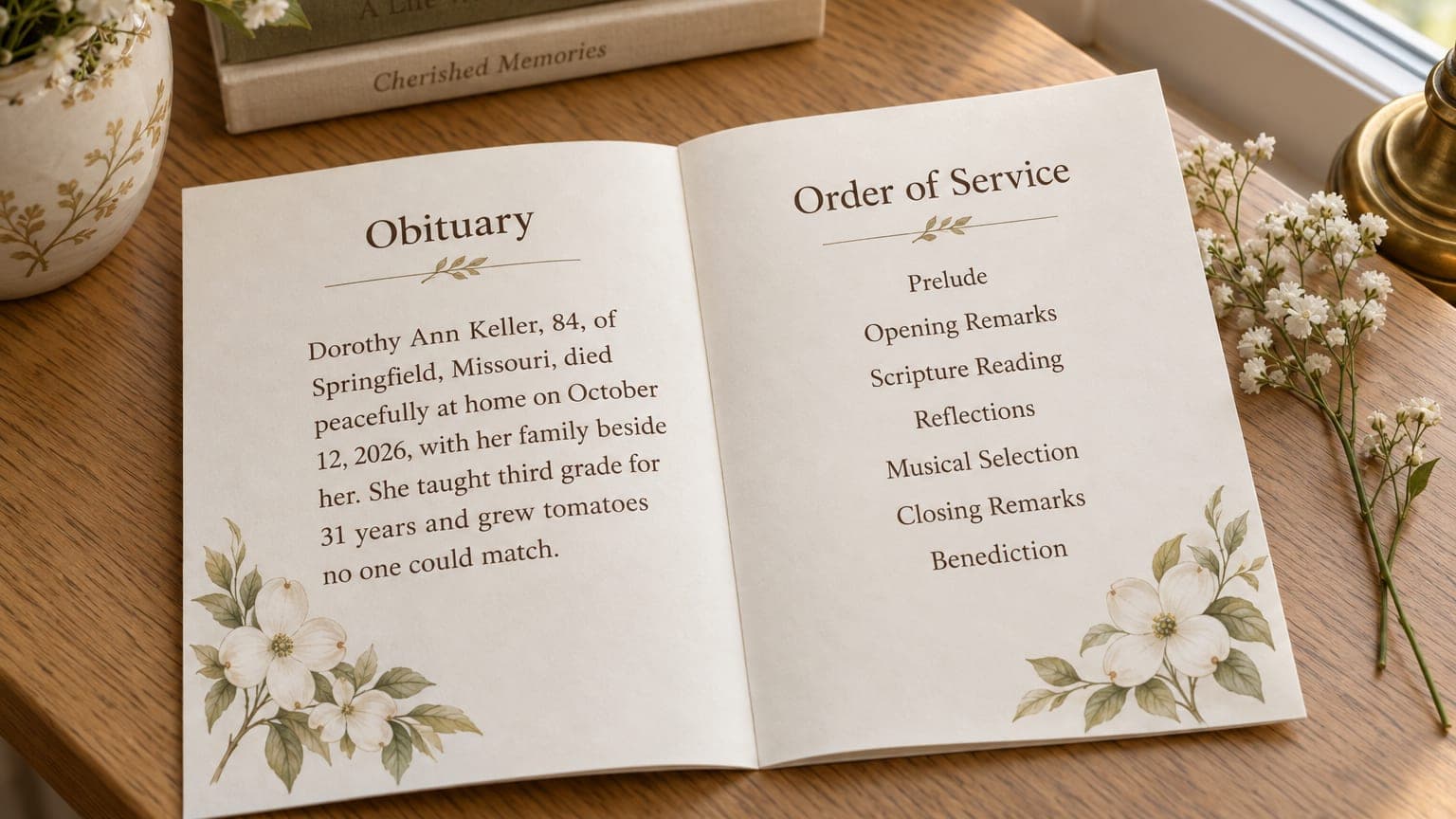
[1. Announcement] Dorothy "Dot" Ann Keller, 84, of Springfield, Missouri, died peacefully at home on October 12, 2026, with her family beside her.
[2. Birth and early life] Dot was born on May 3, 1942, in Joplin, the second of four children of Harold and Ruth Moore. She grew up on her grandparents' dairy farm and never lost the habit of being up before the sun.
[3. Life story] She married Frank Keller in 1963 and taught third grade at Pleasant View Elementary for 31 years. Generations of children learned their multiplication tables from her, and many came back as adults to say so. She grew tomatoes no one could match, played the piano at First Methodist every Sunday, and kept a jar of butterscotch candy for anyone who visited.
[4. Family] Dot is survived by her children, Linda (Mark) Owens and Tom Keller; five grandchildren; two great-grandchildren; and her sister, Jean Moore. She was preceded in death by Frank, her husband of 52 years, and by her brothers, Bill and Ray.
[5. Service details] Visitation will be held Friday, October 17, from 5 to 7 p.m. at Greenlawn Funeral Home. The funeral service will be Saturday, October 18, at 10 a.m. at First Methodist Church, followed by burial at Maple Park Cemetery.
[6. Closing] In lieu of flowers, the family asks that donations be made to the Pleasant View Elementary library. They thank the nurses of CoxHealth Hospice for their kindness.
Take out the bracketed labels and that is a complete obituary of about 250 words. For more finished examples, see obituary examples for a mother, father, husband, wife and grandparents, and our obituary samples in different styles.
Create a funeral program
Prayer selection and obituary writing are included free.
Who Writes an Obituary?
Usually the family. One person often takes the lead — a spouse, an adult child, or the relative who writes best — and others add memories and check names and dates.
The funeral home can help too. Most funeral directors will draft a short obituary from a form you fill in, or check yours and send it to the newspaper with the death notice. Newspapers only write their own obituaries, as news stories, for people who were well known in the community.
Some people write their own obituary ahead of time, or leave notes for their family. If your loved one did, use it; it is a gift.
If you are staring at a blank page, our free obituary writer asks a few questions about your loved one and turns your answers into a full obituary in the order above, which you can then edit word by word. Our step-by-step guide on how to write an obituary walks through each part in more detail, and the obituary template gives you fill-in-the-blank wording.
Where Obituaries Are Published
An obituary can appear in more than one place, and most families now use two or three of these:
- Local newspapers. The traditional home of the obituary, in print and on the paper's website. Newspapers charge for family-placed obituaries, often by the line or word, and a photo usually costs extra. Ask the paper or the funeral home for the rate and deadline before you write, since a long obituary can cost far more than a short one.
- The funeral home's website. Most funeral homes post the obituary on their own site, often with a guest book, as part of their services.
- An online memorial page. A page you create yourself, with no word limit, where you can add photos and the service details and share one link by text, email or social media. A FuneralFolio memorial page is free to create and keep online, and published obituaries also appear in our obituary listings.
- The funeral program. Many families print the obituary inside the funeral program so every guest has the life story in hand. See obituary programs for how families lay it out.
- Social media. A short post with the link to the full obituary reaches friends who don't read the paper.
A common approach: a short obituary or death notice in the newspaper to keep the cost down, ending with "Read Dot's full story at" and the link to the online memorial.
Write a free obituary now
Free, private, no account needed
How Long Should an Obituary Be?
There is no rule. As a guide:
- Newspaper: 150 to 300 words, because you pay for every line.
- Online memorial or funeral home site: 300 to 600 words is common, and longer is fine.
- Funeral program: whatever fits the page, usually 250 to 450 words.
Write the full version first, then cut a shorter one for the paper. It is easier to shorten than to stretch.
Common Phrases Used in Obituaries
These phrases appear in obituaries because they say hard things gently. Use the ones that sound like your family.
Announcing the death
- passed away peacefully
- died surrounded by family
- entered into rest
- went home to be with the Lord
- after a long and courageous illness
- left us too soon
Family
- is survived by
- leaves behind
- was preceded in death by
- (spouse's name) — "Linda (Mark) Owens" means Linda and her husband Mark
- loving wife, mother, grandmother and friend
Service and closing
- a celebration of life will be held
- private services will be held for the family
- in lieu of flowers, donations may be made to
- the family wishes to thank
- she will be deeply missed by all who knew her
To end with something more personal than a stock phrase, a short quote works well. See quotes for loved ones who passed away for lines that fit the last sentence of an obituary.
What Not to Put in an Obituary
A few things are better left out of a public obituary:
- The home address. Funeral homes often advise leaving it out, because the obituary tells strangers when the house will be empty.
- The exact birth date with the mother's maiden name. Together they are common security questions. The birth year, or month and year, is enough.
- Family conflict. Leave out estranged relatives' disputes, and never use the obituary to settle a score.
- Cause of death, unless the family wants it. It is a personal choice. Many families say "after a short illness" or nothing at all.
Questions Families Ask
Does obituary mean death?
Not exactly. "Obituary" comes from the Latin word for death, but it means the written notice of a death and the story of the person's life, not the death itself. You would say "I read her obituary," not "her obituary was sudden."
Where are obituaries typically published?
In the local newspaper of the town where the person lived (and sometimes where they grew up), on the funeral home's website, and on an online memorial page the family shares. Many families also print the obituary in the funeral program.
What is the difference between an obituary and a eulogy?
An obituary is written to be read: it announces the death and gives the facts of a life and the service details. A eulogy is a speech given at the service, more personal and full of stories. Many families start with the obituary and build the eulogy from it; our eulogy writer can help with that step.
How soon after a death is the obituary published?
Usually within a few days, so it appears before the funeral and people have time to plan to attend. If the service details aren't set yet, you can publish the obituary first and add "services will be announced" or update the online version later.
Do you have to publish an obituary?
No. An obituary is a tradition, not a legal requirement. Some families publish only a short death notice, some share an online memorial with friends, and some choose privacy.
Uncredited wording on this page was written for FuneralFolio and is free to use in your own obituary. When you are ready, the obituary writer is free, and the finished obituary can go straight onto a memorial page or into a funeral program.