

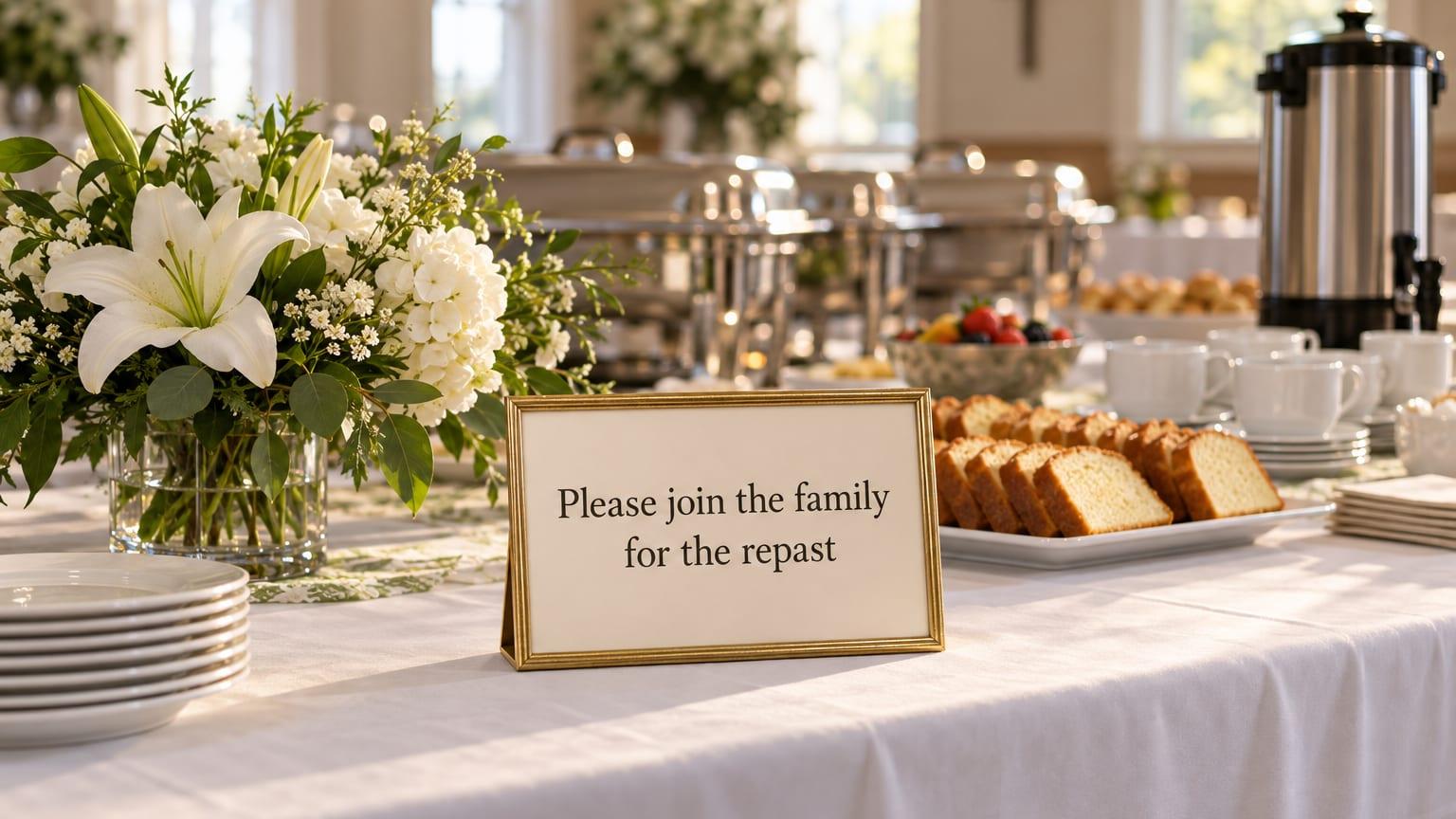
What repast means, how to say it, and how to plan the meal after a funeral: who hosts, when it starts, what to serve, and wording for the program.
Create a funeral program
Prayer selection and obituary writing are included free.
What Does Repast Mean?
Repast means a meal: the food, and the time people spend eating it together. At a funeral, the repast is the meal family and friends share after the service or the burial. The word came into English from Old French (the modern French word for a meal is repas) and goes back to the Latin pascere, "to feed."
In everyday English the word sounds old-fashioned. You see it in phrases like "a light repast" or "an evening repast." Its common use today is at funerals, where "the repast" means the meal after the service.
- How to say it: ri-PAST, with the stress on the second syllable. REE-past is also correct.
- Spelling: repast, not "repass." Repass is a different word that means to pass again.
- Plural: repasts.
What Is a Repast After a Funeral?
A funeral repast is the meal the family offers after the funeral service or the burial. Guests come back from the cemetery, sit down, eat, and talk. For many families it is the first time all day they can catch their breath, and the first real conversation they have with the people who came.
The word "repast" is used most in African American churches and in many Catholic and Southern families. Other families call the same meal:
- a funeral reception or funeral luncheon
- a mercy meal or bereavement meal
- a fellowship meal, when the church hosts it
- a wake, in Britain and Ireland, where the word often means the gathering after the funeral
Many faiths have their own version. In Jewish tradition, friends prepare the seudat havra'ah, the meal of condolence, for the mourners when they come home from the cemetery, often with eggs and other round foods. Greek Orthodox families hold the makaria, a mercy meal that traditionally centers on fish. In Utah, a ham dinner with a cheesy potato casserole is so common after funerals that the dish is called funeral potatoes.
Repast, Reception, Wake: What's the Difference?
The names overlap, and families use them loosely. The usual meanings:
- Visitation or viewing: before the funeral, often the evening before, with the casket present. Food is usually light or none.
- Wake: in the US, another name for the visitation. In Britain and Ireland, often the gathering after the funeral.
- Repast: the meal after the funeral or burial. It is a real meal, usually lunch.
- Reception: any gathering after the service. It can be a full meal (a repast) or coffee and cake.
- Celebration of life: a gathering focused on stories and memories, sometimes held instead of a funeral, often with food. The celebration of life guide covers how families plan one.
Design a funeral invitation
Send beautiful invitations in minutes
Who Hosts and Pays for the Repast
The family hosts the repast and usually pays for it. How much it costs depends on who cooks:
- The church. Many churches have a bereavement, hospitality or culinary ministry that prepares the repast for members' families, in the fellowship hall. Some ask the family to pay for the food or give a donation; for longtime members it is sometimes a gift.
- Family and friends. Relatives and neighbors each bring a dish, often organized by one friend with a list. This is the most common way at a home repast and costs the family the least.
- A caterer. The caterer brings food to the church hall, a community room or the home. Buffet lunches are usually priced per person, so ask for a quote for the number you expect.
- A restaurant. A private room or a reserved section, ordered from a set menu. Many restaurants ask for a minimum spend.
- The funeral home. Some have a reception room the family can use, with catering they arrange.
If the family can't host a meal, coffee, sandwiches and cake after the service are enough. Nobody expects a banquet.
When the Repast Starts and How Long It Lasts
The repast usually starts right after the burial. When the burial is private, far away, or happens on another day, the repast follows the funeral service instead.
- Start time: within 30 to 60 minutes of the burial or service, so guests can drive straight over.
- Length: about one to two hours.
- Time of day: most funerals end late morning or early afternoon, so the repast is usually lunch.
Guests come and go. Close family and friends stay longer; others stay half an hour, speak to the family and leave.
Create a funeral program
Prayer selection and obituary writing are included free.
Planning the Repast
Families planning a funeral have a few days and many decisions. The repast takes three: where, who cooks, and how many people. The funeral planning checklist shows where it fits among everything else.
- Choose the place. The church fellowship hall is easiest when the service is at the church. Otherwise a family home, a restaurant, a community room or the funeral home's reception room.
- Decide who cooks. The church ministry, family and friends, a caterer or a restaurant.
- Estimate the head count. Plan for most of the people at the service. The number of programs you print is a good upper limit.
- Ask one person to run it. A cousin or friend who isn't in the front row: they meet the caterer, set out food, and keep the coffee going, so the immediate family can sit and talk with guests.
- Seat the family first. Many church repasts serve the immediate family before guests, at a reserved table. Tell the servers who the family are.
- Plan the end. Someone packs leftovers for the family. There is always more food than anyone expects.
What to Serve at a Repast
Repast food is comfort food that holds well and is easy to eat with people around you. A typical spread:
- Main dishes: fried or baked chicken, sliced ham or turkey, lasagna, baked ziti, meatballs.
- Sides: macaroni and cheese, green beans, potato salad, collard greens, rice, rolls.
- Lighter options: sandwich trays, wraps, a green salad, fruit, a vegetable tray.
- Desserts: pound cake, sheet cake, cookies, pies, banana pudding.
- Drinks: coffee, tea, lemonade, punch and water.
A few practical points: serve buffet style so people can eat when they are ready; choose dishes that taste fine warm rather than hot; and include something for children and something without meat.
How to Announce the Repast
Guests need to know three things: that there is a repast, where it is, and whether everyone is invited. Say it in more than one place:
- In the program, usually on the back page.
- On the invitation, on the last line.
- In the obituary, in the paragraph with the service details. If you write it with the free obituary writer, add the repast line to that paragraph when you review the draft.
- Out loud. The officiant or funeral director announces it at the end of the service and again at the cemetery.
If the repast is only for family and close friends, say so in writing ("for family and invited guests") and leave it out of the spoken announcement.
Repast Wording for a Funeral Program or Invitation
Copy any of these and change the names and places.
After the service, at the church
The family invites you to join them for a repast immediately following the service in the Fellowship Hall.
After the burial, with an address
Please join the family for a repast following the interment at Greater Mount Zion Baptist Church, 1418 Oak Street, Memphis.
Short line for the bottom of the program
Repast to follow in the church fellowship hall.
At a restaurant
Family and friends are invited to a repast following the service at Rosa's Trattoria, 220 Main Street, Glen Cove.
At a family home
Please join us after the burial for a meal and memories at the home of Linda and James Carter, 48 Maple Drive.
Private repast
A private repast for family and invited guests will follow the service.
In the obituary
Following the burial at Holy Cross Cemetery, family and friends are invited to a repast at St. Anne's Parish Hall, 75 Church Street.
Celebration of life
After the service, stay for food, stories and fellowship in the parish hall.
On a program, the repast line usually goes at the bottom of the back page, after the order of service, the interment details and the family's thank-you. On an invitation it is the last line, where "Reception to follow" usually goes. If you are making the program now, you can start a funeral program and type the repast line on the back page, or put it with the service details on the front. Funeral invitations use the same designs and wording.
Repast Etiquette for Guests
- Do I need an invitation? If the repast is announced at the service or printed in the program without "private," everyone at the service is welcome.
- Should I bring food? Not to a church, catered or restaurant repast. For a repast at home, ask the friend who is organizing it; families often welcome a dish.
- Should I bring a gift? No. A sympathy card is enough, and you may have given one at the service.
- How long should I stay? Half an hour is fine. Speak to the family before you leave.
- What do I say to the family? A short memory of the person who died means more than anything general. "I'm so sorry" is always enough.
- Can I skip the repast? Yes. Many guests go to the service and leave. If you knew the family well, try to stop in, even briefly.
Thanking the People Who Helped
The church ministry, the friend who organized the dishes, the neighbors who cooked: they all deserve a thank-you. A short note in the weeks after is plenty, and a donation to the church's hospitality ministry is a common way to thank a church that hosted. The funeral thank-you wording guide has notes you can adapt, including thanks for food.
Questions Families Ask
Is a repast required after a funeral?
No. A repast is a custom, not a requirement. Families who don't hold one sometimes invite close friends home instead, or simply say goodbye at the cemetery.
Who is invited to the repast?
Everyone at the service, unless the program or invitation says it is private. A private repast is for family and the guests they invite.
Can you have a repast after a cremation or memorial service?
Yes. The repast follows whatever the main gathering is: a funeral, a memorial service, or a celebration of life. After a cremation with no service, families sometimes hold the meal on its own as the main gathering.
How much does a repast cost?
It depends on who cooks. A potluck or a church-prepared meal can cost little beyond the groceries or a donation. A caterer or restaurant usually charges per person, so the guest count sets the price. Ask for a quote before you decide.
Is it "repast" or "repass"?
Repast. "Repass" is a common misspelling, and a different word meaning to pass again.
Do you tip the church volunteers?
Volunteers don't expect a tip. A thank-you note and a donation to the church's hospitality or bereavement ministry are the usual ways to thank them. If a caterer or restaurant served the meal, tip the staff as you would for any event.
The repast wording on this page was written for FuneralFolio. Change the names and places and use it freely in your program, invitation and obituary.